Postflop Trees
IkaSolver can build and solve trees that start from the flop, turn, or river. This is useful for studying specific postflop spots in depth - for example, analyzing a BTN vs BB single-raised pot on a particular board texture.
Setting Up a Postflop Tree
In the New Tree dialog, set the Starting Street to Flop, Turn, or River. This changes the dialog:
- Blinds and antes are hidden - no blinds are posted in a postflop tree since the preflop action has already occurred.
- Starting Pot replaces the blind fields - enter the total pot size at the start of the street (in chips).
- Big Blind is still shown - it is used for display purposes only (EV is expressed in bb/100).
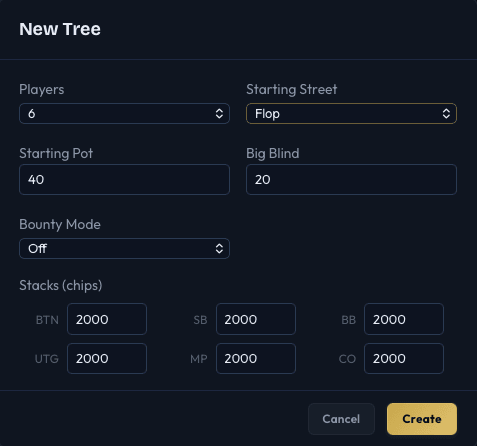
After clicking Create, the Starting Ranges dialog appears so you can set the hand ranges each player arrives at this street with.
Board Card Selection
Before running a postflop solver, you need to select the community cards. The Board Card Picker appears in the lower-left panel, above the Table/Range/Strategy views.
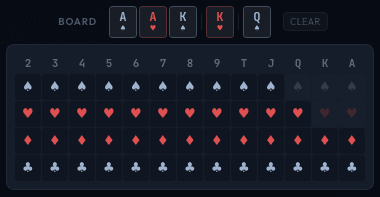
- Click an empty slot (labeled F, T, or R) to open the card picker grid.
- Click a card in the grid to place it. Already-used cards are dimmed.
- The picker auto-advances to the next empty slot.
- Click the x on a placed card to remove it, or use Clear to remove all board cards.
The number of required cards depends on the street:
- Flop: 3 cards
- Turn: 4 cards
- River: 5 cards
The solver will not start until the required board cards are selected. The board card slots glow to indicate when cards are needed.
The Postflop Tab
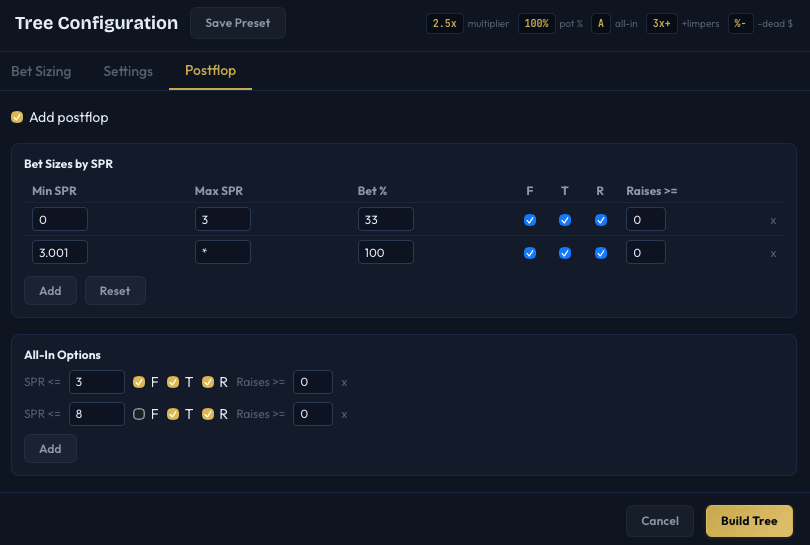
The Postflop tab in the Tree Configuration dialog controls how postflop bet sizes are generated. Unlike the preflop Bet Sizing tab (which uses raise multipliers), postflop sizing is driven by SPR (stack-to-pot ratio) tables.
Geometric Sizing
Geometric (exponential) sizing automatically computes a bet size that splits the remaining effective stack into equal percentage-of-pot bets across the enabled streets, so the player is exactly all-in by the last street.
Enable geometric sizing per street using the Flop, Turn, and River checkboxes. The number of remaining enabled streets determines the bet size:
- Flop + Turn + River enabled: On the flop, computes a bet that — if made on all 3 streets — gets exactly all-in by the river.
- Turn + River enabled: On the turn, computes a 2-street geometric bet to get all-in by the river.
- River only: On the river, the geometric bet is simply the remaining stack (all-in).
The geometric size adjusts automatically at each decision node based on the current stack-to-pot ratio. It is added alongside any SPR-based bet sizes you configure below.
For example, with 100bb effective stacks and a 10bb pot on the flop, enabling all three streets produces a ~40% pot bet on each street, growing the pot geometrically until the stacks are committed.
SPR-Based Bet Sizing Table
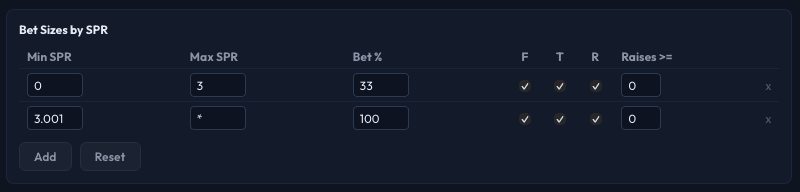
The core of postflop configuration is the Bet Sizes by SPR table. Each row defines a bet size that applies when the stack-to-pot ratio (SPR) falls within a given range:
| Column | Meaning |
|---|---|
| Min SPR | Minimum SPR for this rule to apply (inclusive) |
| Max SPR | Maximum SPR for this rule (use * for infinity) |
| Bet % | Bet size as a percentage of the pot |
| F | Apply on the flop |
| T | Apply on the turn |
| R | Apply on the river |
| Raises >= | Minimum number of raises in the current street before this size becomes available |
SPR is the effective stack divided by the pot. A low SPR (e.g., 1-3) means stacks are shallow relative to the pot, so smaller bet sizes make sense. A high SPR means deeper stacks and room for larger bets.
The default configuration has two rows:
- SPR 0 to 3: 33% pot bet (all streets, 0 raises required)
- SPR 3+ to infinity: 100% pot bet (all streets, 0 raises required)
This means at shallow SPR, only a 33% pot bet is available. At deeper SPR, a full pot bet is used instead.
Use the Add button to create additional rows (e.g., add a 75% pot option for medium SPRs). Use Reset to restore defaults.
All-In Options
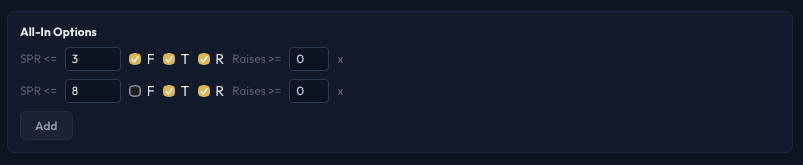
The All-In Options section controls when an all-in bet becomes available postflop, based on SPR:
| Field | Meaning |
|---|---|
| SPR <= | All-in is available when SPR is at or below this threshold |
| F / T / R | Which streets the all-in applies to |
| Raises >= | Minimum raises before all-in becomes an option |
The default setup:
- SPR <= 3: All-in available on all streets (flop, turn, river), 0 raises required
- SPR <= 8: All-in available on turn and river only, 0 raises required
This means at shallow SPRs, players can shove on any street. At medium SPRs, the all-in is restricted to later streets where the pot has grown relative to stacks.
The Settings Tab
The Settings tab contains options that affect both preflop and postflop tree construction.
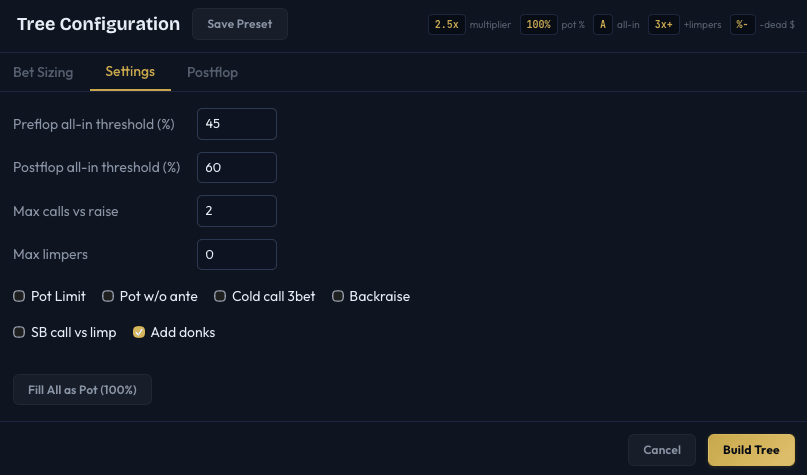
All-In Thresholds
- Preflop all-in threshold (default: 45%) - When a player's raise would commit this percentage of their remaining stack, the raise is converted to an all-in. This prevents unrealistically small raises that leave almost no chips behind.
- Postflop all-in threshold (default: 60%) - Same concept for postflop actions.
Merge Threshold
Merge threshold (default: 0 = disabled, recommended: ~12%) removes redundant bet sizes that are too close together. When two raise sizes are within the threshold percentage of each other, the smaller one is removed. This reduces tree size without meaningfully changing the strategy. Set to 0 to disable.
Force All-In
Force all-in (% stack) (default: 0 = disabled) converts any raise that commits more than this percentage of the effective stack into an all-in. This prevents awkward pot-committing bet sizes. For example, setting this to 67% means any bet committing more than two-thirds of the stack becomes a shove.
Max Calls and Limpers
- Max calls vs raise (default: 0) - How many players can cold-call a raise. Set to 0 for raise-or-fold preflop trees (no flatting allowed). Set to 1 or 2 to allow cold-calling.
- Max limpers (default: 0) - How many players can limp (call the big blind) before someone raises. Set to 0 for open-raise-only trees.
Toggle Options
| Option | Default | Meaning |
|---|---|---|
| Pot Limit | Off | Cap all raises at the pot size (for pot-limit games) |
| Pot w/o ante | Off | Calculate pot percentages excluding the ante |
| Cold call 3bet | Off | Allow players to flat-call a 3-bet (instead of only 4-bet or fold) |
| Backraise | Off | Allow a player who already called to re-raise if action comes back to them |
| SB call vs limp | Off | Allow the small blind to just call when facing a limp (instead of raise-or-fold) |
| Add donks | On | Allow out-of-position players to bet into the preflop aggressor (donk bets) |
Fill All as Pot
The Fill All as Pot (100%) button sets every preflop sizing field to 100%. This is a shortcut for creating pot-limit style trees.
Tips
- Keep SPR rows simple to control tree size. Two or three rows is usually sufficient. Each additional row creates more branches in the tree.
- Use the Raises >= column to add re-raise sizes only after the initial bet. For example, a row with Raises >= 1 and Bet 100% creates a pot-sized raise option that only appears after someone has already bet.
- Adjust all-in thresholds based on stack depth. At 100bb, the defaults work well. For shorter stacks, you might lower the thresholds.
- Postflop trees are faster to solve than preflop trees because they have fewer decision nodes. A full 2-player postflop tree on a single board might have 10,000-50,000 nodes compared to millions for a full preflop tree.
Next Steps
- Editing the Tree - Fine-tune individual nodes after building
- Starting Ranges - Set hand weights for postflop starting points
- Bet Sizing - Preflop-specific sizing configuration